Saturday, 6 September 2014

Let's do it for the kids: the Adinkra symbols project

This is the second post in the series about the arts and crafts workshops for children that I ran almost two years ago with the African Cultural Association, Barnet.
As usual the brief was to encourage children and young people from 7 to 18 to learn and use textile craft techniques to make something, possibly with links to African history and culture.


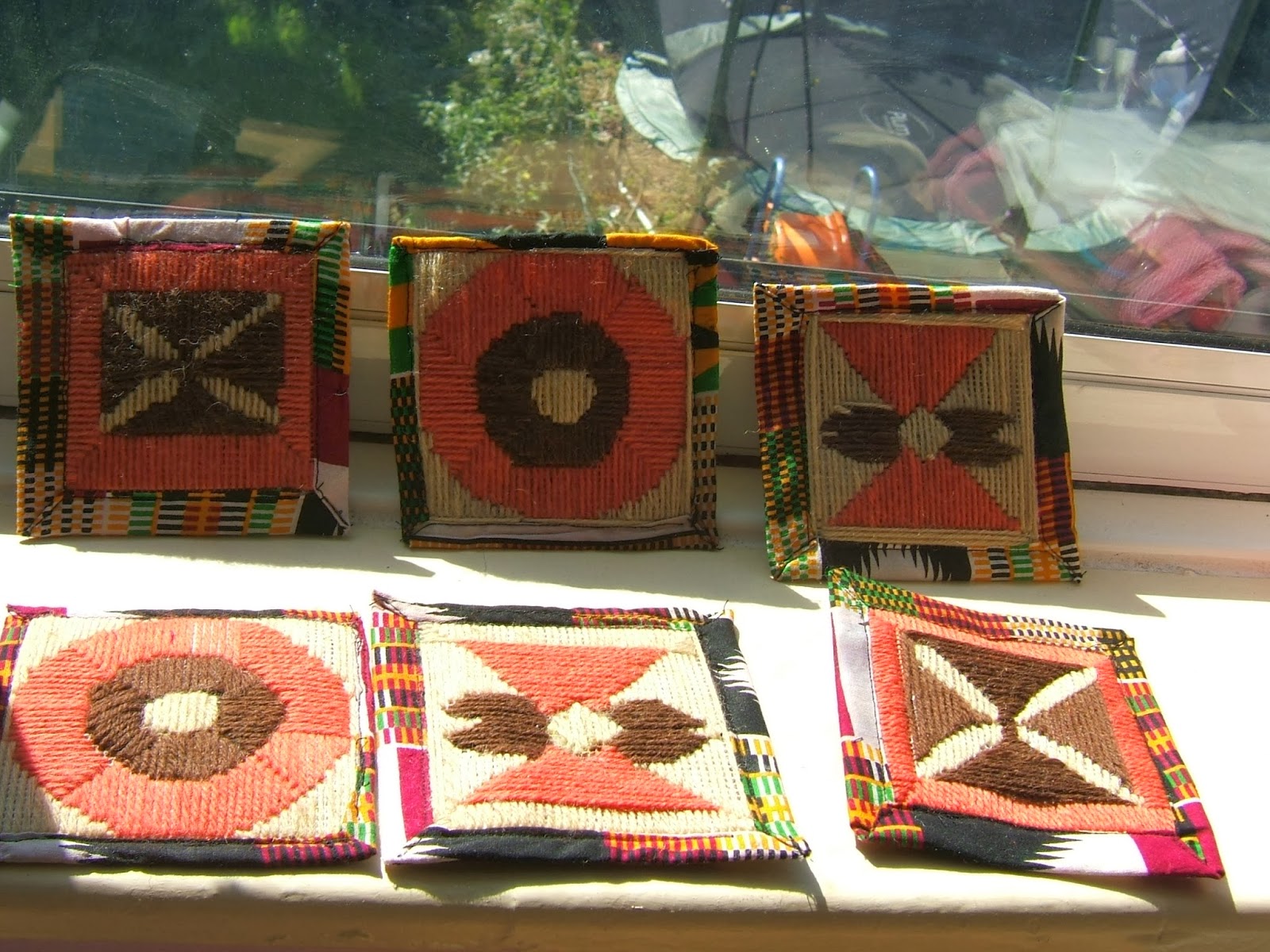
A series of coasters embroidered in long stitch on canvas with Adinkra symbols, bound with African fabrics.

As a great fan and lover of embroidery, something involving embroidery was for me naturally on the agenda from the start. Running a workshop on a drop-in basis carries the risk of not knowing in advance the average ability/knowledge of your  audience, in which case it is safer to assume none.
Activities based on sewing, had previously had a mixed reception: some children loved the challenge, some didn't. The apparent or real complexity of some of the embroidery stitches and styles can be off-putting, especially for children, who are generally looking for quick results that offer satisfaction and a sense of achievement and self-affirmation.
Long stitch kits are usually popular with children as they offer the possibility to quickly fill a simple design with an uncomplicated stitch in order to decorate small items that have a practical use as well. Things like a picture frame, a book cover and so on.

Bookmark Long stitch kit embroidered in wool on canvas
The idea then came to my mind to research some Adinkra symbols that could be adapted, translated and embroidered in long stitches. Adinkra are a series of visual symbols that originated in Ghana (or the neighbouring Ivory Coast) among the Asanti people and are used on hand crafted items, especially on cloth, to convey certain concepts.
A quick useful resource can be found on  this link
http://www.adinkra.org/htmls/list.htm but, a good and more substantial starting point can also be found here
Welcome to Adire African Textiles gallery
I decided to choose some symbols that I thought would be both appealing to children for their meaning and simple to reproduce:
Here are some of the initial sketches and drawings...


The next step consisted in translating the symbols into long stitch patterns that could be embroidered

Translating symbols into long stitch patterns

Three symbols seemed to be fit for purpose for more than one reason (simplicity of execution, concept appeal etc) : one of them was 'royalty', the other was 'peace' and the other was ' good fortune'. I auditioned beforehand the feasibility of the symbols with my audience and was greatly guided by their choices.


The other steps consisted in preparing the canvas, by drawing the design on it and colouring it in to facilitate the execution, a bit like some 'tapestry' (needlepoint) kits that come ready painted with the colours of the threads.                                                                                                                                


One of the coasters embroidered in long stitch on canvas with the "royalty" symbol


The home-made "kits" proved very popular with the children, and some of them not only mastered the long stitch, but also worked out their own version. The resources used were minimal: recycled wool yarn (from my stash!), permanent markers, needles, of course, and scraps of African fabrics. The only relatively expensive item being the 10 holes x inch canvas, which though, yielded quite a few "squares." While we decided to bind the embroidered squares and make them into coasters, they might have been just as easily turned into something else (a book cover, a mini wall hanging etc.).

Wednesday, 7 August 2013

To Iran and back via Wembley part III, the Grand Finale


The time has come to draw a conclusion on this rather rambling multi-instalment post about the tale of my first trip to Iran, and perhaps try to explain what's Wembley got to do with it all.

ready made kamiz from a Wembley shop
My quest for wearable items (clothes that I could wear feeling comfortable both on a personal and on a cultural level) led me to bump right into the multicultural nature and history of London as well as my own: the material I bought from an Indian fabric shop in Wembley to make myself some kind of dress, was wrapped in a newspaper that was the Indian version of a British one and the article printed on it was about ...Italian politics!...

I have started this post talking about the curtains that I was re-purposing  to "set up a studio in my kitchen", which came from the Ikea store in Wembley.

Yes, Wembley isn't  just a place full of ethnic shops (fabric or otherwise); it's home to one of the biggest and strongest global brands there are in this contemporary world: IKEA, and when I say home I mean HOME, yes, to many of us, IKEA means HOME and to many of us home is synonymous with FAMILY.

So armed with my 'provisional clothes' and my 'janamaz' off I went to meet my Iranian family, in particular those members who didn't live in Teheran, but in the Mozandaran region, on the shores of the Caspian Sea
The first of many 'receptions' that were given in our honour in Iran

Some members of the family accompanied us all the way from Tehran to Amol

A view of the Mount Damavand on the way to Amol

A young girl proudly advertising the thriving salmon farming business of the Caspian Sea area
lots of young relatives in a portrait taken in the village of  Gazane, where the family originates


Amongst the presents I was given, as the newly met "bride" at some kind of belated "wedding reception" was a lovely pair of golden filigree earrings which had been specially commissioned by my mother in law to welcome me into the 'family' after nearly twenty tears


I probably have already mentioned how I (and I suspect many of us) have very mixed feelings about  Ikea. I feel that Ikea is a mirror of the way we live : a rich minority of the world starts something small but powerful, which then expands into something bigger and leads inevitably to exploitation of some kind and we all play this game both as victims and perpetrators.
Ikea is appealing: the furniture is flat packed, but of supposed quality. Clean cut, no (much) frills, modernist/ modern,  kind of ecological.  It signifies democratic design: how many of you remember the V&A exhibition of a few years ago (actually it was 1997, how time flies!) about Carl and Karin Larsson the creators of the so called   'Swedish style'? http://www.amazon.co.uk/Karin-Larsson-Creators-Swedish-Style/dp/1851772006/ref=sr_1_1?ie=UTF8&qid=1375544451&sr=8-1&keywords=Swedish+style+Larsson
It was sponsored by IKEA and explicitly tried to link Swedish modernist style with the IKEA brand and ideology.
Yes, there are doubts about the credentials of its founder (suspected of Nazi sympathies by some); yes, we don't know whether somewhere along the line they employ child labour despite their claims that they don't, we are not quite sure about the concept and the products themselves and so on... and yet Ikea means home but a 'new kind of home,' a free one, one steeped in modernist, liberal, Nordic style, social democratic ideology. A caring, yet liberal home, where the kids are free to roam just as they are in the shop, where unlike Victorian British children they can be heard and seen ...it's modern: it's Britain leaves the Victorians and meets Europe along with Morris and ...cheap... (mind you, to a point, you get what you pay for, as they say...), it means that you can dream of starting a home, a family, or even an affordable life as a single person, but part of a bigger community

But Iran was different...
No much need for flat pack (or indeed any) furniture, sleeping on gorgeous carpets as a treat, on the roof of one of the house we went to visit in Amol
The nomadic spirit is ever present and you can feel it in the air, in the readiness to set up a table or a bed almost anywhere, more often than not with stylish implements that seem to materialize out of thin air...

Yet the hunger for modernity, and/or westernization is ever present in such an ancient yet very young country (due to the prevalence of young people in relation to the overall size of the population)
Here is a picture of my family and I with another young relative in a supermarket he owns in Amol
The check out area decorated with old Persian imagery
Above is another example of how they are always trying to re-invent themselves and their identities, by picking and choosing bits of their past
And these are two other  favourite pictures of mine featuring again a traditional style setting, where political and historical icons are placed alongside pictures of  family members often "photoshopped": highlighting crucial moments of their lifes, such as marriages or pilgrimages/trips or just  showing random bits,  taken in one of those "country houses" where they go back to their roots and relax


I am not always abreast of what happens in the international markets, and how these things work in "real life" therefore was a bit puzzled by how 'real' coke could be found in Iran notwithstanding the sanctions and had not a clue whether IKEA was allowed there.
So I was a bit surprised, when some other young relatives who came to greet us good-by at the airport, brought us some more presents carried in bags from ...guess where?...


Tuesday, 11 June 2013

Let's do it for the kids : 1) Stick & stitch: the gadget holder project


Last year I got involved in a project organised by the African Cultural Association, Barnet: The Youth Multicultural Textiles Arts & Crafts Workshops. It consisted of a series of drop-in workshops aimed at children from 7 to 18 (quite a range!) and mainly based in the borough's libraries.

The task proved both exhausting and rewarding but definitely an experience worth remembering and sharing:
It can give some ideas on 'crafty' things to do/make with children and how to plan any of such activities with them.
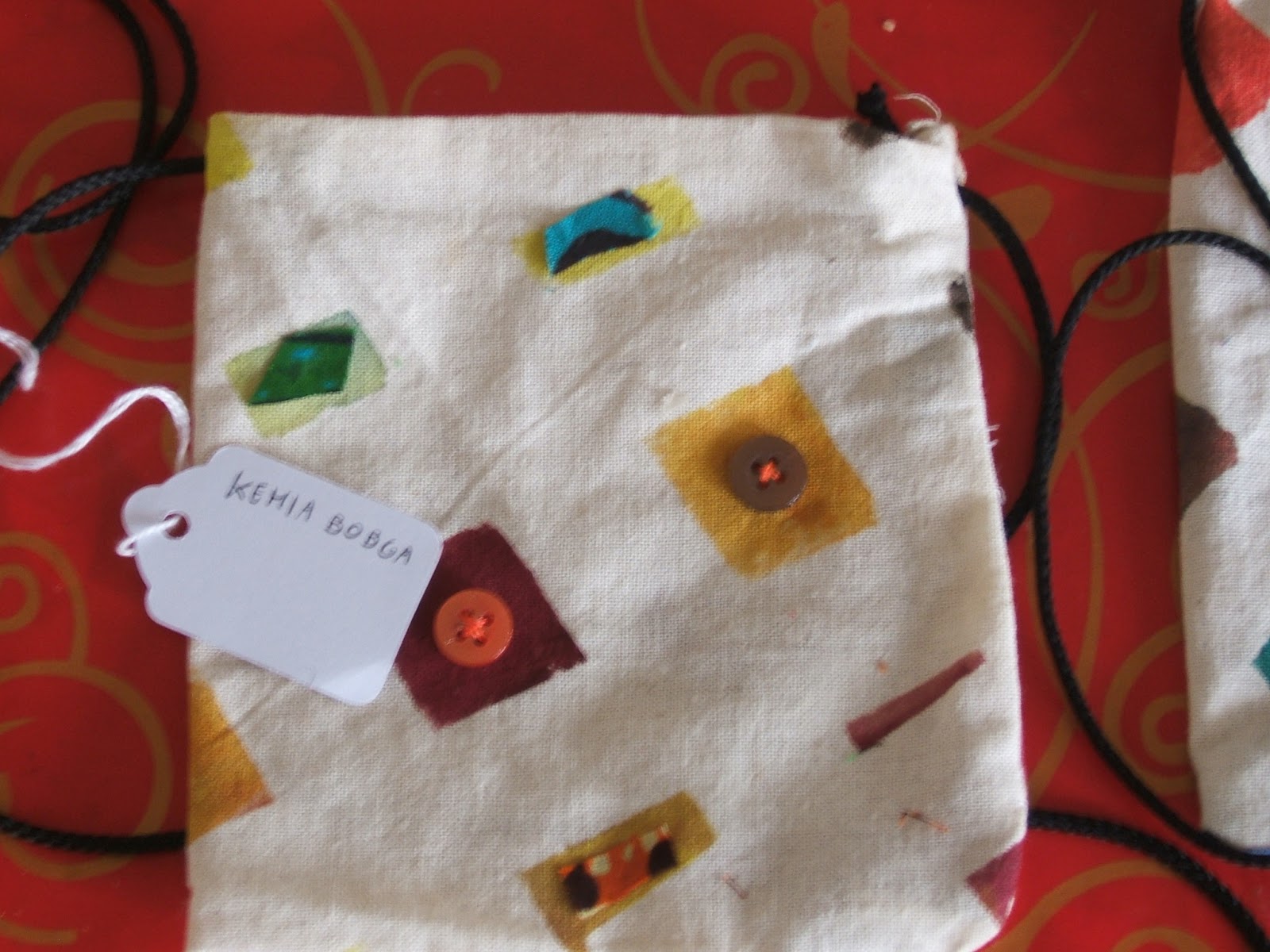
The first project I want to talk about is the gadget holder (ideal as a mobile case or i-pod or even a pair of spectacles), which is basically a rectangular shaped container that can be hung around the neck.

The general brief for the project was to include some kind of textile craft form either traditional or contemporary, drawing on a multicultural context but possibly including some African connection or theme. Obviously there had to be a practical outcome, in terms of artefacts but possibly also in terms of learning (a new skill, technique, etc.)
The idea for this particular workshop came about because I could include fabric (for the textile bit) paint (as some of the children had previously requested something involving a painting activity of some sort) and could accommodate both the needs of children who could sew (and were itching to do so) and children who couldn't or wouldn't, mainly the younger ones, but not necessarily.

It had to be a fairly simple activity as the workshops were becoming increasingly popular and lots of children of different ages would turn up making close supervision a bit more difficult.
Just as some of the children were intimidated by the use of the needle, some of the others were  nervous at the idea of using paints and brushes. To make the project easy to execute I came up with the idea of using masking tape to make a neatly painted background without too much effort and scope for things to go wrong (the idea developed from one the techniques used with Markal Paint sticks, even though in that case you paint over the masking tape and spread it with a toothbrush).

 We used primary acrylic colours which even if mixed to become a bit murky would go well with the bits and pieces of the African fabrics that would be added later for further decoration. Each child decided on the design and on the measures and shape of the case.
 The choice for the main fabric had to be calico: it's strong, doesn't fray  much, it's easy to sew through and reacts well to both paint and glue. So once the off-white calico had been decorated with paint, the rectangles could be folded and there was a choice whether to glue the hems or sew them.


Sewing or gluing the seams was also pretty straightforward, with those wanting to sew getting excited and those not wanting to, enjoying the quick and equally
Laying the masking tape
sturdy results given by the gluing method.


 Pieces of African fabric and/or coloured buttons were added, either by gluing or sewing using simple stranded embroidery cotton and the purses were finished off with the addition of a cord (the sides were pierced with an owl and the cord was knotted in place) to allow them to hung from the neck.


 Whoever had time and wanted to could add further decoration with thread and beads